Can any security glass also be fire-rated?>
Can fire-rated glass also be impact-rated and bullet resistant?>
Can fire-rated glass also be security glass?>
What are the characteristics of bulletproof glass?>
How might security-rated glazing support door hardware in safer school design?>
What's the difference between blast- and ballistic-resistant glass?>
There are many pieces to safer school design. But fire and security doors are key components to minimizing threats to life safety. A white paper from the Partner Alliance for Safer Schools (PASS) underscores this point.
The article discusses how fire doors can support enhanced security, provided they are specified with code-compliant locking hardware. This type of hardware should allow accessible egress for day-to-day use as well as evacuation procedures. In an active shooter situation, locking hardware can be activated from a secure location, whether that is electronically from an office or mechanically at the door, to control where a violent intruder can move.
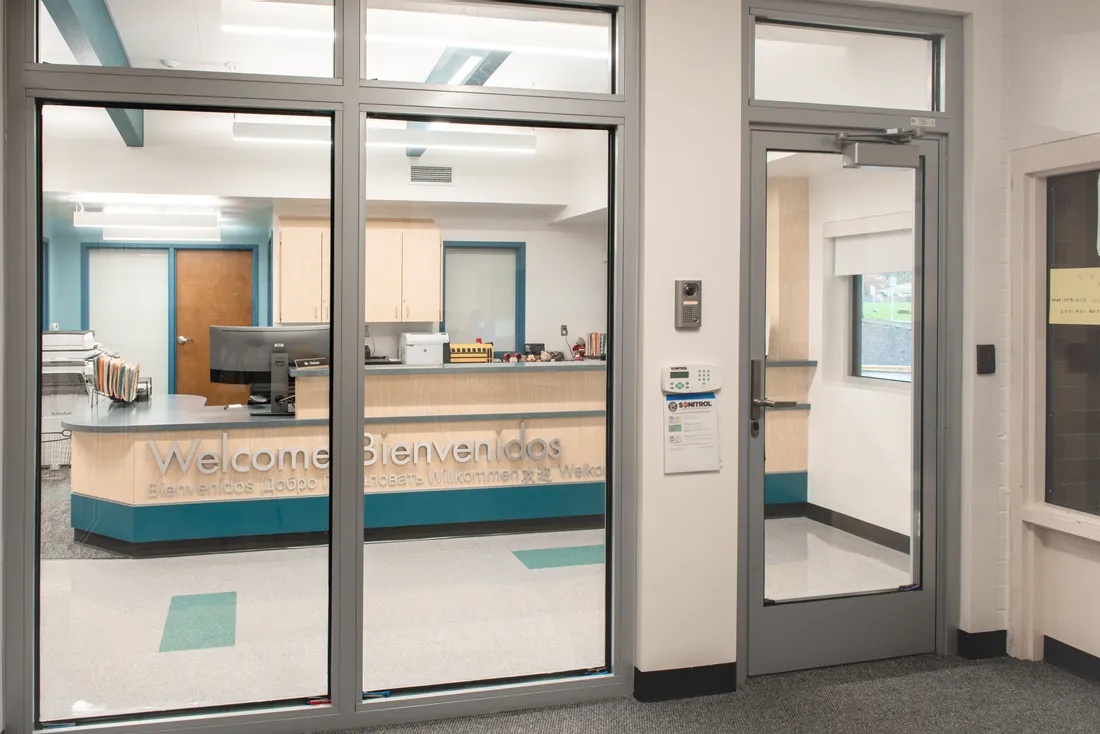
For many of these doors, fire-rated glazing can support visual connection between spaces while maintaining code compliance. However, during lockdowns, glass can be seen as a vulnerable point. Security-rated glazing can support locking hardware by reducing the ability for an intruder to break through and manually unlock a door. In these applications, it is essential to incorporate security-rated components that do not inhibit the system’s fire rating.
Project teams can streamline the design of fire and security doors by understanding the requirements fire doors must meet and best-practice recommendations for safer school design.
When designing multifunctional, fire- and security-rated doors, it is necessary that they fulfill code-driven requirements for compartmentation and safeguarding means of egress. As a model code, the 2024 International Building Code (IBC) details fire-rated glass door requirements in Table 716.1(2). Generally, fire doors must:
Because the criteria for a code-compliant fire door can vary significantly between projects and applications within a project, design teams are encouraged to consult local building codes and clarify any ambiguities with the Authority Having Jurisdiction (AHJ).
Security-rated glazing can allow design teams to plan transparent barriers between occupants and life safety threats. This can be true when it is specified along a school’s façade or within a building’s exterior walls. For instance, when design teams intend fire-rated doors to enhance building security as well, multifunctional, fire- and security rated glass doors align with PASS recommendations. These components reduce weak points in doors to support locking hardware in creating barriers between occupants and life safety threats.
This type of fire and security door also preserves open sightlines, which minimize areas where students can be isolated—another aspect of safer school design.
To enhance school security effectively while maintaining code requirements, project teams must often navigate a complex set of design considerations. But they do not have to do this alone. Technical Glass Products (TGP) can support safer school design with online resources and expert guidance.
Check out TGP’s school design hub to learn more about code-compliant school security.