
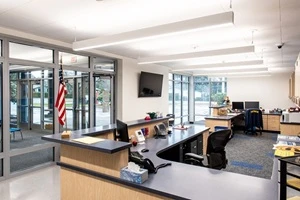
Designing safer schools often involves planning for multiple types of emergencies: fires, active shooters, violent intruders, seismic events and more. There also may be areas where multiple safety features overlap, which can further increase the complexity of safer school design. The list below outlines where fire- and life-safety requirements might intersect with best-practice recommendations for enhancing security from the building perimeter to the classroom door to achieve a safer school design.
In these applications, it is important to note that creating a multifunctional, fire-rated system is not as simple as putting a security-rated component into a fire-rated assembly. This is because many forced-entry and ballistic-rated components are plastic-based and can burn quickly and intensely, potentially inhibiting or negating a system’s ability to defend means of egress paths during a fire.
Explore Technical Glass Products’ (TGP) School Solutions Hub to learn more about systems that support code-compliant safer school design.

Doors with impact-safety-rated glass are able to withstand various levels of impact. For example, when CPSC 16CFR 1201 (Category II) impact-safety-rated glass is struck by an object comparable to a full grown, fast moving adult, it does not shatter, or shatters in a safe pattern to prevent injury.
Prior to the development of the 2006 International Building Code (IBC), the fire-rated glass in doors was only required to satisfy minimal impact performance requirements, even in areas that would normally be required to provide high-impact tempered or laminated safety glazing by building code. Today, fire-rated glazing in all hazardous locations, as specified in IBC Sections 2406.4.1 through 2406.4.7, must also pass an impact safety test. Because doors are often subject to frequent human impact and installed in hazardous locations, all glazing in doors must meet impact-safety criteria. This also typically applies to fire-rated glazing adjacent to or near the door, including sidelites or glass located near the floor.
Since not all fire-rated glass products provide impact safety protection, it is important to verify the selected offering meets either CPSC 16CFR (Category I) or CPSC 16CFR 1201 (Category II) impact classifications, as determined by the application. Fortunately, with the option to select from products like laminated fire-rated glass ceramic and fire-resistive glazing products that provide up to Category II impact-safety ratings, there is no need to choose between fire safety or impact safety. In fact, the codes no longer allow it.
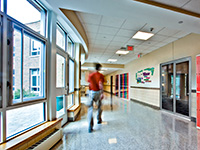
Over the last decade, the rise in active shooter events has fueled advances in manufacturing, resulting in new security glazing options to mitigate these risks. For example, for schools needing a complete, integrated fire and security system, there are now options like Pilkington Pyrostop® laminated to School Guard Glass®. Pilkington Pyrostop is a fire- and impact safety-rated glazing material that blocks radiant heat, while School Guard Glass is a laminated glass product with a security strengthened substrate core designed to slow down intruders. By combining these two proven products, the resulting glazing solution is fire rated for 45 to 120 minutes, impact safety-rated to meet Category I and II requirements and UL 752 Level III bullet-resistance ratings.
Today, more than 40 different voluntary tests apply to security issues, though provisions are not currently mandated in building codes.
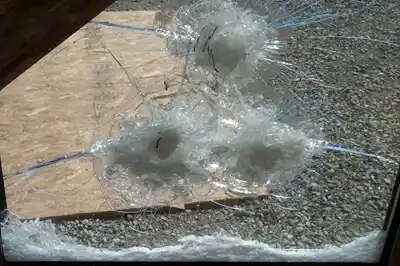
When it comes to enhanced security, there are multiple test standards that quantify the ability for door and window systems to contribute to building hardening efforts. Two of the most often cited ones are the forced-entry resistance standard ASTM International (ASTM) F3561 and bullet-resistance standard UL Solutions (UL) 752.
Both forced-entry resistance and bullet-resistance contribute to enhanced security, but determining which is more appropriate depends on a project’s specific goals. That said, understanding the differences between the two standards is a first step in improving a building’s ability to protect occupants.
Understanding the distinct differences between forced-entry and bullet-resistance standards helps a project team determine the most appropriate security measures for a building. It is a crucial first step in improving a project’s ability to keep occupants safe and secure.
Specifically developed for active shooter events, ASTM F3561 is a forced-entry resistance standard for windows, doors, modular panels and similar products. This standard begins by weakening a system with repetitive shots followed by mechanically driven impact to simulate forced entry. If the glazing and framing stay intact, it passes the test. Important to note, bullet rounds are allowed to penetrate an assembly, so even though the test includes a ballistic component, it does not measure bullet resistance.
ASTM F3561 quantifies the ability for a glazing assembly to provide a time barrier between violent attackers and occupants during an active shooter event, allowing occupants to contact first responders, shelter-in-place or evacuate, depending on preestablished protocols.
Ballistic-rated glazing, often called bulletproof glass, differs from glass rated to ASTM F3561 in that it prevents bullets from breaching a glazing assembly according to the data collected during the UL 752 test standard. UL 752 quantifies an assembly’s bullet-resistance across multiple levels in terms of weapon used, caliber type and shot placement.
These levels do not progress from least protective to most protective but instead focus on specific weapon and ammunition types. No matter the specific rating level, an assembly must not allow projectiles to perforate it completely.
