

How to Specify Fire-Rated Glass for Hospital Stairwell Enclosures
David Vermeulen, North America Sales Director, Technical Glass Products
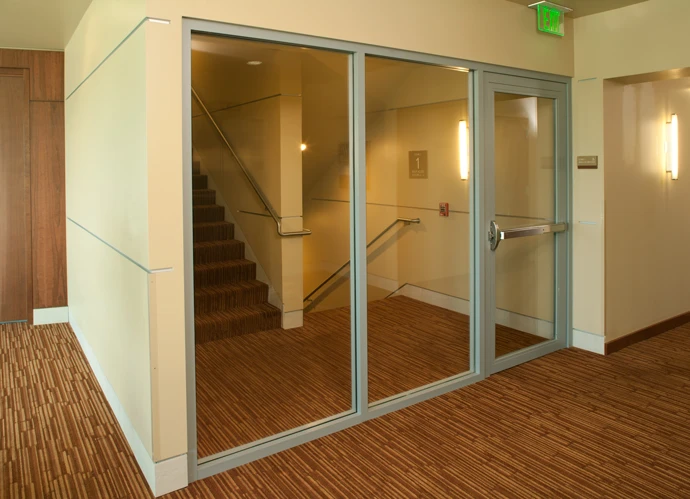
Designing health care facilities often means planning for more stringent fire- and life-safety code requirements than other projects. This is because medical centers must meet egress requirements while also ensuring occupants with limited mobility can safely shelter-in-place. Code requirements influence almost every part of the built environment—from patient room doors to corridors and stairways.
When it comes to hospital stairwell design, advances in fire-rated glazing have turned what were purely functional spaces into inviting, light-filled and visually connected components of a means of egress system. Fire-rated glazing assemblies can be used in stairways for:
- Multistory fire-resistance-rated curtain walls
- Full-lite fire door assemblies (including sidelites and transoms)
- Transparent, fire-rated wall panels
- Vision panels within opaque fire doors
This dive into the requirements for health care stairwell glazing relies on the 2024 edition of the International Building Code (IBC), which classifies hospitals in the Institutional Group I-2. Because local code requirements can be based on different editions of the IBC or different model codes altogether, design teams are encouraged to review local building codes and consult with the Authority Having Jurisdiction (AHJ) to ensure all fire-rated glass in hospital stairwells is code-compliant.
Are all stairwells in hospitals required to be fire-rated?
In short, yes, hospital stairwells will need to incorporate fire-rated materials since they are considered shaft enclosures.
According to section 713.4 Fire-Resistance Rating, the IBC states, “Shaft enclosures shall have a fire-resistance rating of not less than 2 hours where connecting four stories or more, and not less than 1 hour where connecting less than four stories.” The number of stories includes basements but not mezzanines.
To achieve code-compliance, the walls, floors and ceilings enclosing hospital stairwells will need to be fire-resistance-rated; this includes both curtain walls and structural walls. As a result, openings within a stairway will also need to be fire-rated in accordance with Table 716.1(2) Opening Fire Protection Assemblies, Ratings and Markings.
How can fire-rated glass be used in hospital stairwells?
Designers can incorporate fire-rated glass in hospital stairwells is as curtain walls—so long as these assemblies meet code requirements for their application.
For example, the project team behind the Dally Tower at MultiCare Good Samaritan Hospital in Puyallup, Wash., specified fire-rated frames and glass to create a multi-story fire-resistance-rated curtain wall within the building’s central lobby. This lobby contains both an elevator and open stairway, so the curtain wall offered a viable way to meet code requirements for health care stairwell glazing and to maintain access to natural light from neighboring non-rated glazing assemblies.
To support a close visual match between fire-rated and non-rated glazing assemblies, the design team used Fireframes® Curtainwall Series frames with Pilkington Pyrostop® glass to achieve a narrow-profile framing aesthetic and optimal glazing clarity.
More ways to incorporate fire-rated glass in hospital stairwells
In addition to curtain walls, fire-rated glass can be used within opening protectives in hospital stairwells. Unlike curtain walls, which must function like any other fire barrier in terms of fire-resistance, requirements for opening protectives have some leeway, depending on the size of the shaft enclosure.
For shaft enclosures that connect less than four stories, fire doors, sidelites, transoms, wall panels and windows will need to provide fire-resistance ratings for at least 60 minutes and be marked appropriately according to Table 716.1(1) in the IBC. For enclosures four stories or larger, fire doors can be rated for a minimum of 90 minutes while other openings must be fire-resistance-rated for 120 minutes.
As an example, the Highmark Medical Pavilion in Issaquah, Wash., features transparent fire-rated doors with connected wall panels for improved visual connection between floors and stairways. These applications use Fireframes® Aluminum Series frames and Fireframes Designer Series doors, both with Pilkington Pyrostop® glass for fire-protection in a sleek and modern assembly.
Solve multiple design challenges with fire-rated glazing
Designing health care facilities requires project teams to navigate a complex set of building code requirements as well as best-practice recommendations from trusted entities like the Facility Guidelines Institute™ (FGI) and the World Health Organization (WHO). In addition, some projects may seek LEED or Living Building Challenge certification.
Fire-rated glass can help designers achieve code-driven requirements, meet best practices and contribute to more sustainable designs. Technical Glass Products (TGP) offers several fire-rated glazing systems that meet LEED v5 standards and include Environmental Product Declarations (EPDs).
Contact TGP today to explore your options for fire-rated glass for hospital stairwells.

David Vermeulen is North America Sales Director for Technical Glass Products and also the author of the Fired Up blog on Glass Magazine.


