

Planning for Fire-Resistance Rated Requirements Without Compromising Aesthetics
Devin Bowman, General Manager, Technical Glass Products
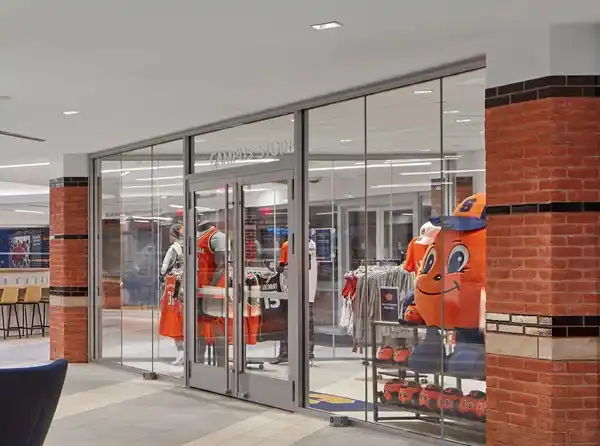
Although necessary, planning buildings around fire- and life-safety code requirements can often make designers feel like they are in a zero-sum game where code compliance and design freedom are mutually exclusive—especially went it comes to creating open, light-filled interiors.
In the past, material limitations for fire-rated glazing set hard limits for how much visual connection and access to natural light a design could incorporate while still meeting the International Building Codes’ (IBC) fire-resistive assembly requirements. But fire-rated glass has changed dramatically over the past 50 years, shifting from small lites of wired glass to expansive, full walls of transparent glazing. In fact, swapping old fire-rated materials for fire-resistance rated glass was integral to Syracuse University’s award-winning renovation to the Schine Student Center.
Of this project, Benjamin Darby, architect at Ashley McGraw Architects, notes, "Visual connection was the primary driver for the design of the renovation." Just as Darby’s team used 1-hour fire-resistive glazing in multiple applications to increase transparency within the building, other firms can use fire-rated glazing to push the boundaries of their designs. But to do this effectively, it is important to know the answers to the following questions:
- What are the IBC fire-resistive assembly requirements for curtain walls and openings?
- Do fire-resistant glazing requirements change when a building has automatic sprinklers?
- Can 1-hour fire-resistive glazing applications also be engineered to support design cohesion?
What are the IBC fire-resistive assembly requirements for curtain walls and openings?
Fire-rating requirements can vary significantly within model and local codes, depending on the building’s intended purpose, the location of the fire-rated assembly, building and room size, the dimensions and function of an assembly and much more.
For example, fire-rated glass curtain walls would likely be defined as a fire barrier or fire partition, depending on where a system terminates in relation to the floor above or dropped ceiling, according to the definitions listed in Chapter Two of the IBC. The fire-resistant glazing requirements for both are commonly determined by two standards: ASTM International’s ASTM E119 or UL Solutions’ UL 263. Receiving classification as non-directional fire-resistance-rated construction (meaning they can maintain the same fire-rating from both sides) rather than an “opening protective,” these fire-rated assemblies can exceed 25 percent of the total wall area to provide transparency from the outside in where fire and life safety is a concern.
Given the difference in application, the fire rating requirements for fire barriers and fire partitions will differ. While fire partitions will likely need a fire-resistance rating of “not less than 1 hour” according to Section 708.3 of the 2024 IBC, fire barriers’ ratings depend on their specific application—a full overview can be found in Section 707.3.1 through Section 707.3.11.
Fire-resistant glazing requirements for doors and windows depend on the rating requirements of the wall assemblies in which they are located. A full explanation of the fire rating requirements for these elements of the built environment can be found in Section 716 of the 2024 IBC.
Do fire-resistant glazing requirements change when a building has automatic sprinklers?
Since the 2021 edition of the IBC, Section 703.2: Fire resistance has stated "The fire-resistance rating of building elements, components or assemblies shall be determined in accordance with Section 703.2.1 or 703.2.2 without the use of automatic sprinklers or any other fire suppression system being incorporated, or in accordance with Section 703.2.3."
The key phrase in this section is "without the use of automatic sprinklers." This means fire-rated assemblies without sprinklers and with sprinkler systems will likely be held to the same rating standards—in accordance with ASTM E119 or UL 263. This is true whether a design team is using opaque fire-rated materials or transparent fire-resistant glazing to meet requirements in jurisdictions that adhere to either the 2021 or 2024 editions of the IBC. There are, for some applications, the ability to seek material alternatives, but that would require the review and approval of an Authority Having Jurisdiction (AHJ), which may be complicated given the IBC’s current phrasing.
Can 1-hour fire-resistive glazing applications also be engineered to support design cohesion?
While meeting code-driven requirements for fire and life safety take precedent over most aesthetic concerns, it should be noted that, historically, there have been significant discrepancies with allowable glazing area and framing profile dimensions between fire-rated and non-rated glazing assemblies. This is due, in part, to the additional weight fire-rated glass has—some options can weigh up to four-times as much as annealed or tempered glass.
One modern method for overcoming this challenge is using cold-formed steel frames. These frames can support a more cohesive design when a fire-rated glazing assembly is in close proximity to a non-rated one. Because steel has greater strength than aluminum, it can hold larger spans of fire-resistant glass without intermediate supports. And when it is roll-formed, this material can be shaped into narrow profiles with crisp edges, which support walls, butt-glazed systems, curtain walls and doors. These details were crucial to the renovation of the 419 Occidental Ave building in Seattle, Wash.
The building’s external stairway utilizes multiple types of glazing to create a unique architectural feature, and a close visual match between the systems’ glass and framing profiles supports both code compliance and the intent behind the design.
When fire-resistant rated glass is a design requirement, specify with confidence
Planning fire-resistant glazing that meets code requirements and supports multiple tenets of occupant wellbeing can be difficult. This is true whether a design firm is following fire-resistive changes in the 2024 IBC or those in a previous edition.
To support architects and specifiers in designing code-compliant and boundary-pushing buildings, Technical Glass Products (TGP) has a wealth of online resources and a deep well of expert knowledge. These resources can help project teams understand IBC fire-resistive assembly requirements at a basic level.
Project teams can also contact TGP to request literature, presentations and more individualized guides to code-compliant, fire-rated design.

Devin Bowman is General Manager of Technical Glass Products (TGP) and AD Systems. With nearly 20 years of industry experience, Bowman is actively involved in advancing fire- and life-safety codes and sits on the Glazing Industry Code Committee (GICC).


