

Fire-Rated Glazing for Zero-Lot-Line Walls: What Architects Need to Know
David Vermeulen, North America Sales Director, Technical Glass Products
While the use of fire-rated glazing is predominately relegated to applications within the built environment, there are contexts for which fire and life safety codes require exterior fire-resistive wall assemblies. Further, some exterior-facing applications require all opening protectives to also have an appropriate fire rating.
For instance, Central Elementary School in Dodge City, Kansas, needed fire-rated exterior windows due to building return conditions that put occupants at risk of fire spreading between wings. However, these are not the only conditions that may require exterior walls and openings to be fire-rated.
Another such condition happens when a building is constructed near to another building or near the property line. Known as fire separation distances, this aspect of code compliance can complicate façade design for new projects and renovations alike.
When might fire separation distances require exterior fire-resistive wall assemblies?
Fire separation distances apply to both the property line and the distance between one building and another on the same lot. Depending on the type of construction, location and occupancy group, the distance that would necessitate exterior fire-resistive wall assemblies can be any distance under 10 feet to any distance under 30 feet (with under 10 feet being the most common). In the 2024 edition of the International Building Code (IBC), Section 705.5 includes a table that outlines these requirements. Project teams are encouraged to consult local building codes to ensure an exterior wall meets all the requirements and to clarify any ambiguities with an Authority Having Jurisdiction (AHJ).
If an exterior wall needs to be fire-rated, it might be the case that its doors, windows and curtain wall systems will also need to a fire rating. As an example, the 419 Occidental Ave building in Seattle, Wash., includes an exterior stairway that is less than 10 feet from a neighboring building. This means its north wall needed to be fire-rated. Following this requirement, the fire wall’s glazing assemblies also needed a fire rating since they are classified as opening protectives.
What are the benefits of fire-rated glass for urban buildings?
While the 419 Occidental Ave project provides an example of the challenges that arise when an exterior wall needs to be fire-rated, it does not answer the question of why a team would specify fire-resistive glass for walls near the property line. Like most exterior glazing systems, the answer usually revolves around optimizing interiors for daylight access, which is well-acknowledged to bolster occupant well-being and support energy efficiency.
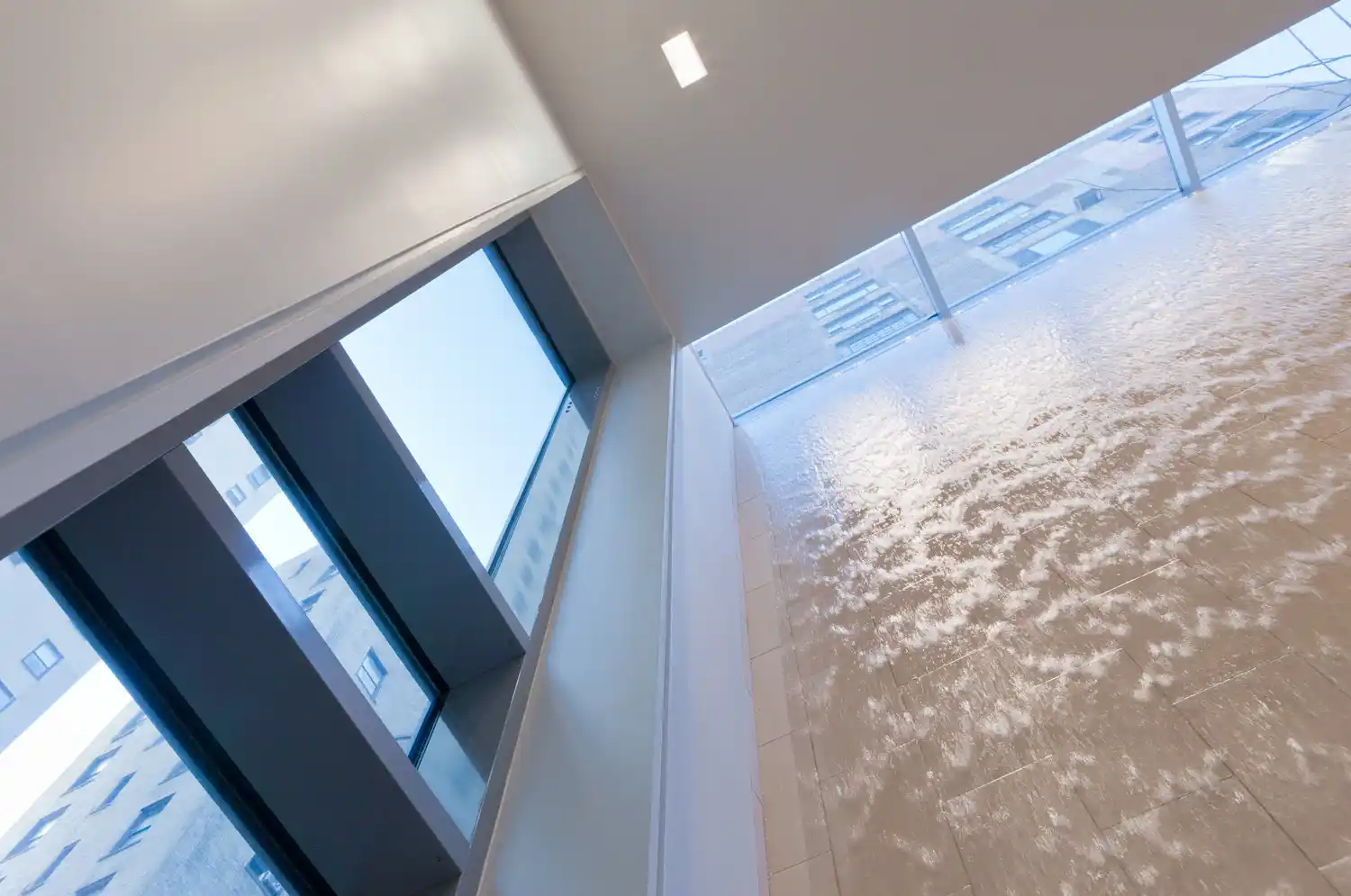
For instance, the designers of the East 80th Street Townhouse specified fire-rated glazing for a zero-lot-line wall. Kate Shin, president of Wemi:t LLC, the firm behind the project, explains, “A lot of times if you go into these townhouses, it’s very dark. We are trying to maximize the efficiency of the layouts, to turn all this dead space into useful space.” The use of fire-resistance rated glazing in this instance allows light to stream into the space’s interior to brighten the townhouse, highlighting the interior design and supporting occupant comfort.
In addition to meeting code requirements, fire-rated glazing within zero-lot-line walls, like Pilkington Pyrostop, can achieve U-values comparable to double-glazed, low-e insulated glass units (IGU) and Sound Transmission Class ratings (STC) of up to 46. As such, they offer value in colder climates and locations where premium acoustic performance drives value.
Impact-safety: another consideration for fire-rated glazing for zero-lot-line walls
Technically, model building codes only mandate impact-resistant glass in “hazardous locations.” That said, in practice, fire-rated glazing will almost always be specified for hazardous locations—whether it is a hallway door or a window in a stairway. Because of this, nearly all fire-resistance rated glazing applications will also need to provide impact safety ratings, often in accordance with ANSI Z97.1 and CPSC 16 CFR1201 (Cat. I and II), to reduce the risk of injury from broken or cracked glass caused by human impact. Exterior fire-rated glazing within zero-lot-line walls is subject to the same hazardous location standards and more.
Glazing in fire walls along a building’s façade play a key role in keeping interiors secure and closed to the elements. A broken exterior lite can create an exploitable opening and inhibit efficient building operation, which makes impact resistance in these applications as important as it is for glazing within an interior. Subject to windblown debris, fire-rated glass for urban buildings is also at risk for gravel and rocks kicked up from vehicles as well as vandalism.
With the product SpeciFIRE® from Technical Glass Products (TGP), design teams can select "exterior" to see their options for fire-resistance rated glazing that can also handle the performance requirements for applications along a building’s façade.
A final word on exterior fire-resistive wall assemblies
When a building needs a fire-rated façade, project teams are no longer restricted to only opaque materials. Whether design would benefit from a full-lite fire-rated door, window or a multistory fire-resistance rated curtain wall, specifiers have a wide variety of glazing for exterior fire-resistive wall assemblies.
TGP can assist building professionals in specifying and installing exterior fire-rated glazing systems that are code-compliant and offer multiple other beneficial performance capabilities, like hurricane ratings. And because systems from TGP feature narrow-profile steel framing, they can provide a close visual match to adjacent, non-rated systems.
Explore how this quality benefitted an Audi Dealership in Birmingham, Mich., then contact TGP today to learn more about specifying fire-rated glazing in zero-lot-line walls.

David Vermeulen is North America Sales Director for Technical Glass Products and also the author of the Fired Up blog on Glass Magazine.


